We went to not one but two new restaurants this weekend. Well, technically one of them wasn't new for Dovie but it was new to me. They were both quite good, and we'll be back.
Granite City
On Friday night we headed over to Granite City, which is a chain brewpub. It opened several years ago, but I've always been kind of leery of the place, mainly due to the fact that it's attached to the mall. I didn't know for sure if it was a chain but kind of had that feeling. But, I wanted to hit up Best Buy and Barnes and Noble and they were over there, so we figured we'd check it out. Eating there definitely overcame my prejudices
Our food was great. I ordered their schmancy bacon cheeseburger, which was quite good albeit a little too big. The rest was my lunch today though, so I'm not complaining. It came with some waffle fries, which are always delicious. Dovie ordered a burrito, which she said was good but not particularly memorable. She was super jealous of my burger and will probably order it next time. We also got cups of clam chowder with our meals, which were the real stars of the show. Both of us declared it to be Alien Abduction* clam chowder after our first bite. It came with some decent bread too - nice and chewy in the way I like.
*Alien Abduction X is what we call things that, if Aliens came to Earth and told us that the fate of the entire planet hinged on how good generic thing X is, we would offer them this version of it. The soup was that awesome.
The beer was pretty good too. The only real complaint was when the waitress screwed up our order. I ordered their wheat beer, and Dovie ordered a Mountain Dew. Somehow Mountain Dew was mistranslated into 'Bock', but it wasn't that big a deal since that was the next beer on the list I was going to try anyway. I also finished off dinner with their Stout, which was good but not as much as the first two beers (though to be fair, I wasn't in as much of a Stout-y mood, I just wanted to try theirs). They were a little more beer-snobby than I would like. I enjoy beer, but don't really care that much about things like beer-dish pairing or any description longer than 10 words or so. Maybe I'm just a Philistine. A to Z's review complained that the place was tooting its own horn at every turn, but we didn't feel that way. It could just be that they visited the place not long after it opened. We did get an ad for their weekend brunch on the takeaway box afterwords.
All in all, it was pretty good. The menu and the general ambiance of the place reminded me of Blue Ridge Grill back in VA, which is a mini-chain that my parents are big fans of. I actually like GC better since it's cheaper and has a great beer selection. We'll definitely be back (prob on a friday night again for the chowder).
Post-script to this meal - after I finished off that last beer and was a little tipsy, we headed over to Barnes and Noble, where I basically ignored this post of mine and bought the rest of the Wheel of Tedium books that I don't own.
Manna Cafe
Manna Cafe is a coffee shop/restaurant/bakery in a extremely unassuming strip mall the north side of town. Dovie had lunch there with her on-maternity-leave boss a few weeks ago and loved the place. We headed there for brunch this morning and it was pretty good. I figured it would be a hole-in-the-wall place based on the exterior, but it was quite nice inside and waaay larger than it looked. I think it was recently renovated.
I ordered the french toast with bacon, because I'm a sucker for french toast and their variety was made from cinnamon sticky buns. But as usual I was kind of underwhelmed by it. The strawberries on top were probably the best part. A few years ago the platonic ideal of french toast in my brain must have changed, because since then it has seemed that every time I make/order it I've been disappointed. It was still good, don't get me wrong, but it still felt like kind of a letdown. I thought their bacon was a little too crispy too, so I might get something else on the side next time (i.e. potatoes). Dovie ordered the Wisconsin Omelet, which had Chevre (PURE WIN), caramelized onions (yet more win), basil. tomato, and other things that I'm forgetting, and a side of potatoes. I tried some of both and they were incredible.
I'd love to go back here for lunch. Jennie got their turkey club last time and declared it an Alien Abduction sandwich. The rest of their menu looks pretty intriguing to me too...
March 07, 2010
New food
November 14, 2009
Book review: The Gathering Storm (Wheel of Tedium book 12)
I was very excited when I went to the bookstore last week and picked up a copy of The Gathering Storm. I hadn't even realized it was out yet - we were there buying the last of the Meg Langslow books that my wife (and I) have been reading. When I spotted the book I thought "this is it! Finally the last book in this series!". It turns out I was wrong - it was merely 'part 1' of the last book in the series. The author died a few years ago but he and his wife (who is also his editor) passed on his notes to another fantasy author to finish it up. After you've already written 11 huge books in a storyline you need some kind of closure.
I've got a long history with the Wheel of Time (aka Wheel of Tedium). It was one of the first mainstream fantasy series that I began reading back when I was 11 or 12 years old. The first three books of the series are very good - it's your usual epic tale of three youngsters in a fantasy world with Destinies and Magic and all the usual stuff you expect to find. Then Jordan was hit HARD by plot bloat. Too many storylines spiraled out from his main story, and at times you lost sight of the original three main characters that started off the piece. In later books, it was not unheard of for one of them to not appear (or at least not have a POV at all), and it was hard to keep track of many of the marginally important peripheral characters who kept popping up.
As far as the new book goes, it was a good read and grabbed me in a way the last few books did not - I read the last 300 pages or so pretty much in one sitting. I can pick out a few reasons why:
- Stuff actually happened in this book. Several of the recent books (most notably, Crossroads to Twilight) were very light on both action and plot points. You can only read so many impromptu planning sessions where everyone disagrees with each other and is always glaring and getting nothing done. Everyone in this universe is incredibly convinced that they are Right and everyone else is Wrong (and generally, idiot children for doing/thinking what they do) and never bends in their judgement. This time around people actually made decisions and confronted their enemies (or did stuff despite the objection of their allies). Of course the bigger thing was that people didn't spend as much time fuming over what everyone else has done. Basically the outline of the last few books has been:
- First 600 pages - eveyone fumes and argues over the Major Event that happened at the end of the last book and tries to figure out how it works to their advantage
- Next 50 pages - people start making plans
- Next 50 pages - one of the POV characters does something
- This book largely consisted of POVs that I actually gave a crap about (and in one case, changed my opinion of one of the other major POV characters). Honestly, I think one of the main reasons I enjoyed this book was the total lack of Elayne Trakand in it. I've never really liked her, but was okay with her when she was a secondary character in the B storyline of Egwene/Nynaeve/Elyane, even though that storyline wasn't really my favorite either. But Elayne has always had that whiny-princess-who-is-'actually tough' but is really just incredibly bitchy/catty vibe that drives me nuts.
Of course, that's kind of a problem with all of Jordan's women from what I can tell. I don't know if he hates women or what his deal is. Almost all of the women in this series are incredibly bossy and opinionated, which is fine, since women absolutely should be assertive and have opinions. However, nearly all of them can be incredibly catty with other women and think that all men are idiot children who can never make a single decision for themselves and require the guidance of a woman just to tie their shoes, and are always seeking to manipulate everyone around them in any way possible. Some of that has to do with the Aes Sedai in these novels - there is a big large-scale power imbalance because for the past 2000 years women have been the only ones who can work magic in this world, and those who can live centuries-plus long lives and are experts in scheming. However, this is true of women even outside of that community as well (see, for example, Faile Bashere) and can be incredibly frustrating. The main character (the Dragon Reborn) is a kind of messaianic figure who's supposed to lead the forces of the world against the forces of darkness in an armageddon-ish battle, and all everyone (various Aes Sedai factions, other empires, all led by women) can think of is how best to get him under their control so they can be the ones in charge.
Anyway, I did change my views on one of the POV characters in the series. In the last few books one of the main characters was raised to be the leader of the rebel faction of Aes Sedai, despite (or really because of) her youth and inexperience. They wanted a leader they could use as a puppet but found an actual leader who actually led them, which is a real rarity in these books. In this book she had been captured by their opponents and their batshit crazy leader and managed to undermine her entire regime by merely being the bigger person for once, instead of the usual route of skulking, scheming, and arguing with everyone about semantics for pages upon pages upon pages (there's a reason why the series is nicknamed the Wheel of Tedium).
It could just be that new the author is pressed for time/space now (since presumably he only has a book deal for these last three books, but whatever it is, thank goodness we're getting more plot points now.
Anyway, long story short (heh), I did really enjoy this book and I'm tempted to re-read all of them again. I sold all of my copies when I heard Jordan died a few years ago though. As I've got plenty of books yet to read (and my dissertation...) I guess it will just have to wait.
September 14, 2009
Book Review: Barbarians at the Gate

Continuing a streak of Helyar reviews, I read Barbarians at the Gate last May. I'd heard good things about it, and I certainly enjoyed Helyar's book on baseball, if you read my last review. I know very little about corporate America, so it was in interesting look at high-stakes finance and the LBO-mania of the 1980s. From an informative point of view, I actually enjoyed it more than Michael Lewis's (of Moneyball fame) Liar's Poker.
The book centers around Ross Johnson and the feeding frenzy that ensued when he tried to ram a 'little' deal for himself and his company that was essentially the largest deal in Wall Street history under the radar. Johnson and his cabal would get a huge sum of money as a part of the buyout, and the whole saga was used as a symbol of corporate greed in the 1980s. I'm not sure what was more hilarious, that the guy's name was Ross Freaking Johnson or the fact that he looked like every caricature of a 80s busniessman that Kids in the Hall ever did:  .
Because it was the biggest buyout in Wall Street history at the time, if drew out all the major companies and flared up all their petty rivalries as they tried to either defend their place at the top or make a name for themselves. I found the book surprisingly easy to read and all the characters fascinating. It's apparently been reprinted 20 times and has been hailed as the greatest business 'history' book ever, and I can certainly see why. I never though a Leveraged Buyout could be so interesting!
September 11, 2009
Book Review: Lords of the Realm
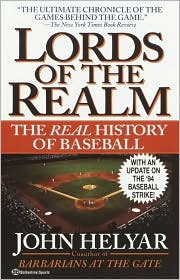
I've been so lazy about reviewing these books that I've gone and reread the book already. It's especially egregious in this case, as this is one of my favorite books that I've ever read - certainly the best baseball book. It's written by John Helyar, who was one of the co-authors of Barbarians at the Gate (which I also read this summer).
The book is basically a history of the owners of baseball (the so-called Lords), and by extension the business of baseball. The blurb on the back describes several of the colorful characters in the history of the game, but the real meat of the book lies in its history of owner-player relations, especially the rise of the players' union from the early 60s up until the 94 strike. A lot of it focuses on the players battles with the reserve clause (Flood, Hunter, Messersmith, McNally), but one thing it points out was that salary arbitration arguable became the best victory the players had against the owners.
I must say, after reading this book I have HUGE respect for Marvin Miller, and all the player leaders of that era. Suddenly I'm a much bigger fan of Joe Torre, Phil Garner, and (gasp) Tim McCarver. Miller was their leader, but he did a great job in those days in making sure that everyone was involved. He educated the player-leaders about labor relations and they took the lead in negotiating several CBAs, with Miller only as a consultant. I don't remember who mentioned it, but when Kuhn was recently elected into the HOF while Miller was snubbed, it was just a 40 years-delayed 'fuck you' from the Lords to their old enemy. It's a travesty that a bumbling idiot like Kuhn is there and Miller is not.
The other, related story, is of course about the owners themselves and their inability to agree on what to have for lunch, let alone what is in the best interests of their businesses. It shows how much money baseball was losing (or projected to lose) that they were able to keep collusion going for 2 years in the late 80s. If any commissioner has had a real impact on the game it's probably Ueberroth, since he was the one who dragged baseball into modern business (especially with regards to TV), though collusion poisoned labor relations for years afterwords. The book ends with the rise of Bud Selig's clique and a precursor of the large vs small market battles that have dominated recent baseball history. Fun bonus: we get to see a pre-political George W. Bush running around as owner of the Rangers.
I highly recommend this book to anyone who enjoys baseball
May 24, 2009
Book Review Clearinghouse - The Omnivore's Dilemma and thoughts on food
Since I'm waiting out a hailstorm in a Starbucks here in Los Alamos, I thought I'd finally get to work on clearing out my list of things I've read. Many of these books I read *a year ago* while here at Los Alamos, so I'm shamefully behind.
The Omnivore's Dilemma, by Michael Pollan
This was a fascinating read, albeit pretty depressing.
The first half of the book is all about industrial farming. I knew that corn is in just about everything, but the stuff he reported on in the book went even above and beyond what I thought about corn's dominance of the food market. The thing that surprised me the most is that a vast majority of the corn we see growing in the fields is not edible as it is grown - most of it goes to huge processing plants where it is broken down into 'corn commodities', like corn syrup and the myriad of corn-derived chemicals that you see on your food labels. I don't remember if it was this book or somewhere else (but probably this book) that pointed out that agriculture is incredibly susceptible to Prisoner's Dilemma-type situations. The price of corn (or whatever) goes down, which entices you to plant more and more crops on your land, which further drives down prices and continues to suck the nutrients out of your land. Smart policymaking *could* fix this, but the dept of agriculture is very much in the hands of big agriculture and is geared for large-scale farming, which is incredibly short-sighted and where monoculture farming fits their profit models much better. Current agricultural policy vastly discourages diversity in farming (unless you consider switching between growing nothing but soybeans and nothing but corn 'diversity'), which is much better for long-term farming outlooks. Pollan didn't mention it much in this book, but the Corn industry's lobbying power is why HFCS is cheaper than sugar in the US.
The other big topic in the first part of the book is where most of our meat comes from. Probably the most interesting fact that I came away with was that the old 'corn-fed beef' cliche that we've been inundated with for years is a fallacy in and of itself. Cow stomachs were evolved to digest grass, and are not able to correctly digest corn. Industrial meat 'growers' use corn as a method to fatten up their cows quickly. It does lead to that nice marbled steak which is the gold standard of the meat industry, but in order to keep the cows healthy while they eat all that corn, they have to pump them full of medicine and antibiotics etc in order to make sure that they stay alive long enough to be slaughtered. It's similar for chickens, though for different reasons. Most industrial chickens are heavily medicated due to their close conditions, as opposed to eating an unnatural diet (corn fattens them up too, but chickens are more versatile). The living and slaughtering conditions are quite disgusting too (lakes of manure = gross), but somehow I don't have quite as much of a problem with it. Maybe because it's not a chemical issue, I don't know, but I think it's something that can be more easily fixed, even if it means more expensive meat. I know that both problems come from large-scale production, but somehow I see the first problem as more fundamentally wrong, while the sanitation stuff is more of a cost-cutting type thing. But I digress.
The rest of the book was about sustainable farming, with a brief final chapter on hunting and foraging (that I didn't find all that interesting). The sustainable farm that he visited (and worked in) was in the Shenandoah Valley in Virginia and was quite fascinating. Their farm was incredibly integrated with nature and natural patterns, and he had several cool methods for his farm. Probably the coolest was the pest control/sanitation - his chickens moved around in a mobile henhouse (which I think was an old schoolbus, I can't remember) that followed the cows around as they rotated pastures. Eash day he'd let them out and they'd eat all the bugs that inevitably bred in the cow manure that the cows left behind. His chickens laid the most incredible eggs, according to the Charlottesville chefs that bought them, because they ate what chickens evolved to eat - bugs (not grains). There was a long section describing his various battles with the ag department (mainly over his chicken-slaughtering operation), and it was pretty cool all around.
The problem with his farm (and larger scale organic operations), is that they only work because they are so small-scale. They do not scale well and require a lot of manpower to generate the amount of food that people require. In my opinion, though things are getting better as far as awareness goes, nothing will change until there is a FULL change in food culture, which I do not see happening. Due to the economics of industrial agriculture, the cheapest foods are the foods that are most processed and soaked with chemicals. which adds another dimension to the culture wars in this country. It's no surprise that the right jumped all over Obama when he made his infamous 'cost of arugla' comment during the primary season. But until prices get a lot closer, fast and processed food will be a large part of our consumer culture.
American food culture is spreading too, especially as regards to meat, and ingrained food habits are very hard to change. 2 years or so ago I was challenged by a fellow mathematician that I met (who was a vegetarian) to try to go a whole week without eating meat, or even go a whole week only eating meat once a day. It was a lot harder than I thought - it's been ingrained that a meal isn't a meal without some meat in it. It doesn't help that I find most protein substitutes unappetizing, for the most part. I like tofu and other soy stuff *sometimes*, but for the most part, it subtracts from my enjoyment of what I eat. I think I do eat less meat now than I used to, but I'm not too broken up about it. I like most meat, a lot. The biggest thing I (usually) remember to ask myself is when I'm making a meal is whether having meat in/with it really necessary? I've more or less stopped eating meat on the few occasions when I have breakfast (unless I have a bacon jonesing), often omit it from pasta sauces, and usually choose other toppings for pizzas that I make/order for myself. The other key thing that I try to remember is Pollan's mantra from his other book (In Defense of Food): "Eat food, not a lot, mostly plants". I do a pretty good job at the first one, though not as good at the other. I've found that I like vegetables a lot more than I used to, but it's still hard to get over my childhood prejudices against vegetables - they're still too complementary in my head.
August 02, 2008
Neon Genesis Evangelion, take 3
While here at Los Alamos, I've been playing through assorted old console games on my laptop (yay emulators!) Recently, I've been working my way through Xenogears, which has held up to be as good as I remembered...and now I'm itching to plow through Xenosaga again, which is pretty up and down. Anyway, this review is not about video games, but about an anime series. All the giant robots, psychological stuff, and veiled (and not so veiled) religious references put me in the mood to watch some Neon Genesis Evangelion, which I have carried from computer to computer since I downloaded it way back in my undergraduate days.
I originally watched the series back in high school, and enjoyed them. I love stories with all sorts of conspiracies, wheels-within-wheels situations, and all the mythological/religous/existential references always serve to make things seem even more epic. One of the reasons I think I enjoyed it so much was that I (mostly) identified with the main character. I don't have the daddy/abandonment issues that Shinji has, but I definitely vibed with his general antisocial-ness and low-level fear of human contact. Watching it ten years later though, Shinji came off as way too emo for me...and since Shinji is the protagonist for the show, the (several) existential Shinji episodes weren't really doing it for me.
As far as other characters go, I'm still not sure how I feel about Asuka. The first time I watched it I HATED her - thought she was just real bitchy and mean in general. Watching them through again (mainly in Japanese w/ subtitles rather than dubbed), I realized that a lot of that stemmed from Asuka's english voice actress, whose voice was very nasal and had a strong undertone of contempt in pretty much every word. Don't get me wrong - Asuka is very bombastic and opinionated, and has a very aggressive personality...but I think the Japanese voice actress did a much better job with her general tone. Asuka can still be pretty selfish and mean-spirited (her most common saying is "What, are you stupid?", after all), but I felt much more sympathetic to her this time around. Also her last battle in End of Evangelion was one of the best action sequences in the entire series, only topped by the feral and terrifying battle between Zeruel and Unit 1.
The battles in the series were pretty amazing - I love the way that the Evas are rendered and, well, just MOVE in general. They manage to capture an almost feral, animal aura around them (clearly, this was intentional) which I think works really well in the giant robot fighting setting. The robots themselves aren't running around with shit tons of guns/missiles/etc (see, Transformers) - they mainly fight hand to hand and though they do use guns you feel much more like they are tools for their task rather than an integral part of the Evas. Whenever we see 'conventional' attacks by the military it always cracks me up, because you just see giant walls of missiles bullets etc raining on the enemy with no effect, which would feel more surprising if it weren't for the super-inaccurate world of robot cartoons that I've seen.
For some reason, the mystery in the show seemed a lot less epic than I remembered...I feel like I missed one of the background episodes somehow - especially in regards to all the stuff that happened in the past, Rei's history, and the ramp up to the Eva project (though I did watch the episode that covered this!). I finally did watch the full version of End of Evangelion and I gave the first half a big thumbs up...but found the ending no more satisfying than the anticlimactic ending to the TV show. I'm probably not going to watch it again anytime soon...though I'll probably feel the itch again the next time I roll through Xenogears (now that I've finished that, I'm all in the mood for Xenosaga again...)
Series of Unfortunate Events
I'm finally getting around to writing book reviews for all the stuff that I've read over the past few months. Farthest back in my queue is A Series of Unfortunate Events, by Lemony Snicket (note: SPOLIER ALERT for anyone who thinks they might read these)
Quick overview: The series consists of 13 books that chronicle the lives of the Baudelaire orphans, whose parents have just died in a mysterious fire. They have a large inheritance that is being held for them until they come of age, and the book chronciles their (mis)adventures as they try to elude the villainous Count Olaf, who is trying to seize their money.
The books are written really well - my main reaction reading this is that I would have LOVED it when I was a kid. They're written for people who love reading - lots of obvious (and not so obvious) literary references, black humor, complicated and made-up words, and a wheels-within-wheels type mystery. The books start out with a standard formula: the kids move to a new foster home with a distant relative, Count Olaf shows up in disguise and hatches some scheme, the kids foil it, and they are forced to move on somewhere else. It gets grating after awhile, but luckily these books are quick reads, and the series switches gears after the 6th book, when they start learning more about the events that their parents were mixed up in, and after the 7th book, when the Baudelaires are on the run after being framed for murder.
In the end, it very much is not a children's book. The line between good and evil blurs slowly over the couse of the book, as we get some insight into the pasts of many of the villains and the good guys aren't revealed to be all that good at times. At several points towards the end the main characters wonder whether they've become villains themselves. The children are exposed to the adult world, which has very few sympathetic characters, even among those who were helpful to the children (not to mention the fact that the most sympathetic characters tend to end up dead).
In the end, they are eventually freed from Count Olaf's interference, and have seen a lot of their preconceptions about the world and their parents torn down. They've seen the world, and it's just pretty nasty and petty in general and are questioning their own actions. Whether I view the ending as good or bad depends on how I'm feeling...if I'm in a good mood and feeling optimistic, then I think that they will be able to use the lessons they've learned from their mistakes (and the many mistakes etc of the people they encountered) to raise and educate Beatrice and be positive forces for change in the deeply flawed world around them. If I'm feeling grouchy, then I feel that the Baudelaires are doomed to repeat the mistakes of the previous generation. Most of the mystery surrounding Count Olaf, VFD, and the events of the past are left unsolved, which left me feeling deeply unsatisfied and almost cheated in a way. But, maybe the fact that the children seem to be letting go of all of this baggage from the past is a sign that history will not repeat itself, and the optimist in me is the winner.