The HBO Game of Thrones TV series has been greenlit!!! (linikifcation).
It makes me very glad that by the time this comes on the air, I will have a job that will actually allow me to afford things like cable.
Showing posts with label books. Show all posts
Showing posts with label books. Show all posts
March 02, 2010
Nerd Glee ensues
February 12, 2010
Add it to the pile
I haven't made a new post about books in about 3 months, when I reviewed the most recent Wheel of Tedium book. I surprised myself with how much I enjoyed it, and it really turned my opinion about one of the characters around that I had previously lumped in with some of the shrill harpies that populate this series. Anyway, it was enough to get me to reread them, which meant I had to go out and re-buy them as I had sold my original copies off after the author passed away a few years ago (the series has been passed on to another author, with Jordan's blessing). Our B+N had the first 6 books, so I bought them and I'm most of the way through book 5.
While out on our quasi-Valentine's date today, we stopped by the B+N on the other side of town which had the rest of them and I grabbed the rest of them...but after about 5 minutes I changed my mind and put them back. I've got a big backlog of books that I've been meaning to read, and I did resolve to make a little more effort to read new stuff rather than re-reading things that I've read many times before (but very much enjoy). In the past 3 months I've read those 5 Jordan books and re-read the excellent Tawny Man trilogy (the last book of which is my sentimental favorite for best fantasy novel). But, here's what I have piled up to read:
- The rest of Bryson's A Short History of Nearly Everything
- The rest of The Book: Playing the Percentages in Baseball
- The rest of Simmons's The Book of Basketball
- Bryson's I'm a Stranger Here Myself
- Bryson's Notes From a Small Island
- Bryson's The Life and Times of The Thunderbolt Kid (You can tell I'm a big Bryson fan)
- #17 on the KLAW 101 Jonathan Strange and Mr. Norrell
- Klaw 101 #15, The Wind-Up Bird Chronicle
- Klaw 101 #42 Brideshead Revisited
- Marvin Miller biopic A whole different ballgame
- Joe Posnanski's excellent The Soul Of Baseball: A Road Trip Through Buck O'Neil's America
- Posnanski's The Machine
- The Neyer/James Guide to Pitchers
- The new BP Annual
- The Hardball Times Annual
- The 2010 Cubs 'Anal', with 2 articles by Shawn
I picked up Wind-Up Bird Chronicle after putting the WoT books back. A skim of the back cover makes it seem like it's pretty cool. Not that I agree with Klaw on his rankings in general - I was not a fan at all of his #1, The Master and Margarita, and my wife (who I view as a good authority on this) thinks that Emma, his #3, isn't nearly as good as the other two Austen books (P+P and Persuasion) on the list and isn't as good as one (Sense and Sensibility) that didn't make the cut. A curious selection. He also has Jane Eyre and Wuthering Heights in there, both of which I despised in high school. He does score huge points for including Lonesome Dove though (at 98),
Anyway, I have my work cut out for me. I'm going to finish reading through WoT #6 and then get back to work on these things...
November 14, 2009
Book review: The Gathering Storm (Wheel of Tedium book 12)
I was very excited when I went to the bookstore last week and picked up a copy of The Gathering Storm. I hadn't even realized it was out yet - we were there buying the last of the Meg Langslow books that my wife (and I) have been reading. When I spotted the book I thought "this is it! Finally the last book in this series!". It turns out I was wrong - it was merely 'part 1' of the last book in the series. The author died a few years ago but he and his wife (who is also his editor) passed on his notes to another fantasy author to finish it up. After you've already written 11 huge books in a storyline you need some kind of closure.
I've got a long history with the Wheel of Time (aka Wheel of Tedium). It was one of the first mainstream fantasy series that I began reading back when I was 11 or 12 years old. The first three books of the series are very good - it's your usual epic tale of three youngsters in a fantasy world with Destinies and Magic and all the usual stuff you expect to find. Then Jordan was hit HARD by plot bloat. Too many storylines spiraled out from his main story, and at times you lost sight of the original three main characters that started off the piece. In later books, it was not unheard of for one of them to not appear (or at least not have a POV at all), and it was hard to keep track of many of the marginally important peripheral characters who kept popping up.
As far as the new book goes, it was a good read and grabbed me in a way the last few books did not - I read the last 300 pages or so pretty much in one sitting. I can pick out a few reasons why:
- Stuff actually happened in this book. Several of the recent books (most notably, Crossroads to Twilight) were very light on both action and plot points. You can only read so many impromptu planning sessions where everyone disagrees with each other and is always glaring and getting nothing done. Everyone in this universe is incredibly convinced that they are Right and everyone else is Wrong (and generally, idiot children for doing/thinking what they do) and never bends in their judgement. This time around people actually made decisions and confronted their enemies (or did stuff despite the objection of their allies). Of course the bigger thing was that people didn't spend as much time fuming over what everyone else has done. Basically the outline of the last few books has been:
- First 600 pages - eveyone fumes and argues over the Major Event that happened at the end of the last book and tries to figure out how it works to their advantage
- Next 50 pages - people start making plans
- Next 50 pages - one of the POV characters does something
- This book largely consisted of POVs that I actually gave a crap about (and in one case, changed my opinion of one of the other major POV characters). Honestly, I think one of the main reasons I enjoyed this book was the total lack of Elayne Trakand in it. I've never really liked her, but was okay with her when she was a secondary character in the B storyline of Egwene/Nynaeve/Elyane, even though that storyline wasn't really my favorite either. But Elayne has always had that whiny-princess-who-is-'actually tough' but is really just incredibly bitchy/catty vibe that drives me nuts.
Of course, that's kind of a problem with all of Jordan's women from what I can tell. I don't know if he hates women or what his deal is. Almost all of the women in this series are incredibly bossy and opinionated, which is fine, since women absolutely should be assertive and have opinions. However, nearly all of them can be incredibly catty with other women and think that all men are idiot children who can never make a single decision for themselves and require the guidance of a woman just to tie their shoes, and are always seeking to manipulate everyone around them in any way possible. Some of that has to do with the Aes Sedai in these novels - there is a big large-scale power imbalance because for the past 2000 years women have been the only ones who can work magic in this world, and those who can live centuries-plus long lives and are experts in scheming. However, this is true of women even outside of that community as well (see, for example, Faile Bashere) and can be incredibly frustrating. The main character (the Dragon Reborn) is a kind of messaianic figure who's supposed to lead the forces of the world against the forces of darkness in an armageddon-ish battle, and all everyone (various Aes Sedai factions, other empires, all led by women) can think of is how best to get him under their control so they can be the ones in charge.
Anyway, I did change my views on one of the POV characters in the series. In the last few books one of the main characters was raised to be the leader of the rebel faction of Aes Sedai, despite (or really because of) her youth and inexperience. They wanted a leader they could use as a puppet but found an actual leader who actually led them, which is a real rarity in these books. In this book she had been captured by their opponents and their batshit crazy leader and managed to undermine her entire regime by merely being the bigger person for once, instead of the usual route of skulking, scheming, and arguing with everyone about semantics for pages upon pages upon pages (there's a reason why the series is nicknamed the Wheel of Tedium).
It could just be that new the author is pressed for time/space now (since presumably he only has a book deal for these last three books, but whatever it is, thank goodness we're getting more plot points now.
Anyway, long story short (heh), I did really enjoy this book and I'm tempted to re-read all of them again. I sold all of my copies when I heard Jordan died a few years ago though. As I've got plenty of books yet to read (and my dissertation...) I guess it will just have to wait.
September 14, 2009
Book Review: Barbarians at the Gate

Continuing a streak of Helyar reviews, I read Barbarians at the Gate last May. I'd heard good things about it, and I certainly enjoyed Helyar's book on baseball, if you read my last review. I know very little about corporate America, so it was in interesting look at high-stakes finance and the LBO-mania of the 1980s. From an informative point of view, I actually enjoyed it more than Michael Lewis's (of Moneyball fame) Liar's Poker.
The book centers around Ross Johnson and the feeding frenzy that ensued when he tried to ram a 'little' deal for himself and his company that was essentially the largest deal in Wall Street history under the radar. Johnson and his cabal would get a huge sum of money as a part of the buyout, and the whole saga was used as a symbol of corporate greed in the 1980s. I'm not sure what was more hilarious, that the guy's name was Ross Freaking Johnson or the fact that he looked like every caricature of a 80s busniessman that Kids in the Hall ever did:  .
Because it was the biggest buyout in Wall Street history at the time, if drew out all the major companies and flared up all their petty rivalries as they tried to either defend their place at the top or make a name for themselves. I found the book surprisingly easy to read and all the characters fascinating. It's apparently been reprinted 20 times and has been hailed as the greatest business 'history' book ever, and I can certainly see why. I never though a Leveraged Buyout could be so interesting!
September 11, 2009
Book Review: Lords of the Realm
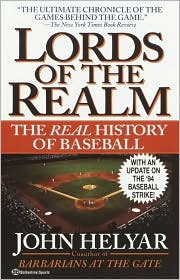
I've been so lazy about reviewing these books that I've gone and reread the book already. It's especially egregious in this case, as this is one of my favorite books that I've ever read - certainly the best baseball book. It's written by John Helyar, who was one of the co-authors of Barbarians at the Gate (which I also read this summer).
The book is basically a history of the owners of baseball (the so-called Lords), and by extension the business of baseball. The blurb on the back describes several of the colorful characters in the history of the game, but the real meat of the book lies in its history of owner-player relations, especially the rise of the players' union from the early 60s up until the 94 strike. A lot of it focuses on the players battles with the reserve clause (Flood, Hunter, Messersmith, McNally), but one thing it points out was that salary arbitration arguable became the best victory the players had against the owners.
I must say, after reading this book I have HUGE respect for Marvin Miller, and all the player leaders of that era. Suddenly I'm a much bigger fan of Joe Torre, Phil Garner, and (gasp) Tim McCarver. Miller was their leader, but he did a great job in those days in making sure that everyone was involved. He educated the player-leaders about labor relations and they took the lead in negotiating several CBAs, with Miller only as a consultant. I don't remember who mentioned it, but when Kuhn was recently elected into the HOF while Miller was snubbed, it was just a 40 years-delayed 'fuck you' from the Lords to their old enemy. It's a travesty that a bumbling idiot like Kuhn is there and Miller is not.
The other, related story, is of course about the owners themselves and their inability to agree on what to have for lunch, let alone what is in the best interests of their businesses. It shows how much money baseball was losing (or projected to lose) that they were able to keep collusion going for 2 years in the late 80s. If any commissioner has had a real impact on the game it's probably Ueberroth, since he was the one who dragged baseball into modern business (especially with regards to TV), though collusion poisoned labor relations for years afterwords. The book ends with the rise of Bud Selig's clique and a precursor of the large vs small market battles that have dominated recent baseball history. Fun bonus: we get to see a pre-political George W. Bush running around as owner of the Rangers.
I highly recommend this book to anyone who enjoys baseball
July 16, 2009
Book Review Clearinghouse: The Master and Margarita
I was very excited to read this book, due to references to it in Everyone Drunk But Me, not to mention that Keith Law put it as #1 in the Klaw 100. I came away disappointed though, finding the main characters unlikeable and the plot too scattershot to keep me very interested.
One of the main things that bothered me about the book is that you don't really meet the title characters until halfway through. The Master is a tortured writer, shattered by the fact that his bizarre (and interesting, from what we see of it) history of the death of Christ from Pontius Pilate's point of view has been rejected by publishers, and mopes around an insane asylum. Margarita, his lover, makes a deal with the Devil (who has shown up with a cast of amusing cohorts to make mock of Soviet society) to bring him back to her so they can live together. Shenanigans ensue and she gets some measure of revenge, and the quasi-religious stuff from the Master's book is folded into it as well. I didn't really get either of them I guess. - I thought the Master was a jerk and can't really understand why Margarita would be in love with him.
As for the other (human) characters, I found them pretty unlikeable/uninteresting as well. The first half of the book was pretty much the devil and co wreaking havoc on all the social climbers etc within the communist society. I guess this was supposed to be a scathing indicment of the communists, but it all seemed pretty tame to me. Maybe I would have liked it if I was reading this from the perspective of someone who thought atheism was inconceivable or that soviet society itself is amusing in and of itself. Social climbers tend to be idiots, no matter what form of government you're operating under.
What I did like about the book was the excerpts/history from the Master's book about Pilate. I'm really just a sucker for biblical history (true or not), so I thought all of that was pretty cool. You do end up feeling sorry for Pilate in this account, but he's a pretty pathetic guy. The Devil's retinue were fairly amusing, especially Behemoth, the flippant giant cat who had "an affection for chess and vodka".
Maybe I'm just a Philistine, I don't know. But this book was not very enjoyable.
May 24, 2009
Book Review Clearinghouse - The Omnivore's Dilemma and thoughts on food
Since I'm waiting out a hailstorm in a Starbucks here in Los Alamos, I thought I'd finally get to work on clearing out my list of things I've read. Many of these books I read *a year ago* while here at Los Alamos, so I'm shamefully behind.
The Omnivore's Dilemma, by Michael Pollan
This was a fascinating read, albeit pretty depressing.
The first half of the book is all about industrial farming. I knew that corn is in just about everything, but the stuff he reported on in the book went even above and beyond what I thought about corn's dominance of the food market. The thing that surprised me the most is that a vast majority of the corn we see growing in the fields is not edible as it is grown - most of it goes to huge processing plants where it is broken down into 'corn commodities', like corn syrup and the myriad of corn-derived chemicals that you see on your food labels. I don't remember if it was this book or somewhere else (but probably this book) that pointed out that agriculture is incredibly susceptible to Prisoner's Dilemma-type situations. The price of corn (or whatever) goes down, which entices you to plant more and more crops on your land, which further drives down prices and continues to suck the nutrients out of your land. Smart policymaking *could* fix this, but the dept of agriculture is very much in the hands of big agriculture and is geared for large-scale farming, which is incredibly short-sighted and where monoculture farming fits their profit models much better. Current agricultural policy vastly discourages diversity in farming (unless you consider switching between growing nothing but soybeans and nothing but corn 'diversity'), which is much better for long-term farming outlooks. Pollan didn't mention it much in this book, but the Corn industry's lobbying power is why HFCS is cheaper than sugar in the US.
The other big topic in the first part of the book is where most of our meat comes from. Probably the most interesting fact that I came away with was that the old 'corn-fed beef' cliche that we've been inundated with for years is a fallacy in and of itself. Cow stomachs were evolved to digest grass, and are not able to correctly digest corn. Industrial meat 'growers' use corn as a method to fatten up their cows quickly. It does lead to that nice marbled steak which is the gold standard of the meat industry, but in order to keep the cows healthy while they eat all that corn, they have to pump them full of medicine and antibiotics etc in order to make sure that they stay alive long enough to be slaughtered. It's similar for chickens, though for different reasons. Most industrial chickens are heavily medicated due to their close conditions, as opposed to eating an unnatural diet (corn fattens them up too, but chickens are more versatile). The living and slaughtering conditions are quite disgusting too (lakes of manure = gross), but somehow I don't have quite as much of a problem with it. Maybe because it's not a chemical issue, I don't know, but I think it's something that can be more easily fixed, even if it means more expensive meat. I know that both problems come from large-scale production, but somehow I see the first problem as more fundamentally wrong, while the sanitation stuff is more of a cost-cutting type thing. But I digress.
The rest of the book was about sustainable farming, with a brief final chapter on hunting and foraging (that I didn't find all that interesting). The sustainable farm that he visited (and worked in) was in the Shenandoah Valley in Virginia and was quite fascinating. Their farm was incredibly integrated with nature and natural patterns, and he had several cool methods for his farm. Probably the coolest was the pest control/sanitation - his chickens moved around in a mobile henhouse (which I think was an old schoolbus, I can't remember) that followed the cows around as they rotated pastures. Eash day he'd let them out and they'd eat all the bugs that inevitably bred in the cow manure that the cows left behind. His chickens laid the most incredible eggs, according to the Charlottesville chefs that bought them, because they ate what chickens evolved to eat - bugs (not grains). There was a long section describing his various battles with the ag department (mainly over his chicken-slaughtering operation), and it was pretty cool all around.
The problem with his farm (and larger scale organic operations), is that they only work because they are so small-scale. They do not scale well and require a lot of manpower to generate the amount of food that people require. In my opinion, though things are getting better as far as awareness goes, nothing will change until there is a FULL change in food culture, which I do not see happening. Due to the economics of industrial agriculture, the cheapest foods are the foods that are most processed and soaked with chemicals. which adds another dimension to the culture wars in this country. It's no surprise that the right jumped all over Obama when he made his infamous 'cost of arugla' comment during the primary season. But until prices get a lot closer, fast and processed food will be a large part of our consumer culture.
American food culture is spreading too, especially as regards to meat, and ingrained food habits are very hard to change. 2 years or so ago I was challenged by a fellow mathematician that I met (who was a vegetarian) to try to go a whole week without eating meat, or even go a whole week only eating meat once a day. It was a lot harder than I thought - it's been ingrained that a meal isn't a meal without some meat in it. It doesn't help that I find most protein substitutes unappetizing, for the most part. I like tofu and other soy stuff *sometimes*, but for the most part, it subtracts from my enjoyment of what I eat. I think I do eat less meat now than I used to, but I'm not too broken up about it. I like most meat, a lot. The biggest thing I (usually) remember to ask myself is when I'm making a meal is whether having meat in/with it really necessary? I've more or less stopped eating meat on the few occasions when I have breakfast (unless I have a bacon jonesing), often omit it from pasta sauces, and usually choose other toppings for pizzas that I make/order for myself. The other key thing that I try to remember is Pollan's mantra from his other book (In Defense of Food): "Eat food, not a lot, mostly plants". I do a pretty good job at the first one, though not as good at the other. I've found that I like vegetables a lot more than I used to, but it's still hard to get over my childhood prejudices against vegetables - they're still too complementary in my head.
April 10, 2009
The Good Old Days Are Now: Review of Time and Again
Jennie recently reread Time and Again, which we both read as a part of our high school history class to get a sense of the Victorian Era (I think), and she suggested that I reread it as well (I barely remembered anything that happened in the book). Here's the basic gist of what happens (note: spoiler alert):
Si Morley is a graphic artist living in NY in 1970, and he joins with a government/academic/military joint venture that seeks to do time travel through some phlebotenum-y explanation of the structure of space-time and self-hypnosis. Si signs up for the program and decides to shoot for Victorian-era New York to solve a the mystery of a puzzling letter in the posession of his girlfriend. He has some initial successes and eventually goes on to fall in love, has an exciting and death-defying adventure in the process of solving his mystery, and returns to the present time as a success story for the program. Up to this point I enjoyed the book, but the ending really ruined it for me. The powers that be in the present time want to use time travel to alter the past, and the leader of the project (understandably) freaks out at the possible moral reprucussions it may have. Si is sent on a mission to alter the past (and essentially eliminate the possibility of Castro coming into power - I've never understood the 60s/70s obsession with Cuba). Instead, with the tacit agreement of the project leader, he ensures that the project leader's parents never meet, ensuring that the program he was in never gets started. He then travels back to the 1880s to live out his life with his 'new' love.
All this I would be happy with, except for the justification for returning to the 1880s. Si very clearly is not looking to rock the boat as far as changing the past goes, and if he had hinged his decision to return on his love for Julia, I would be happy with this ending. Instead, the book slathers on the 'the past was a simpler time' and 'people were happier' whitewash of the Good Old Days, which just drives me crazy. As far as I'm concerned, the Good Old Days are Now. Instead of being happy for Si, I spitefully want him to die horribly of cholera or something 6 weeks after the book ends.
March 06, 2009
(Belated) Book Review: Liar's Poker
Liar's Poker, by Michael Lewis (who also penned the infamous Moneyball), was a sobering read --- my main reaction to it was to wonder why Wall Street hadn't completely gone to shit already, and this was going on in the 1980s
Quick recap: Michael Lewis, an art-history major, gets a masters degree in economics and scores a job with Salomon Brothers, one of the biggest wheel firms in Wall Street at the time. They had been printing money following the deregulation of mortgage backed securites (which eventually led to the savings and loan crisis), and were hiring up all the students from the prestigious schools. They learn about trading through their unorthodox and sometimes arbitrary-seeming company training, and are thrown into the fire, where their real training begins. Wall Street (or at least, the bond market) is built on a Screw-Thy-Neighbor type policy - exploiting all the weaknesses and ignorance of those around them to make money. Deregulation provided vastly more opportunities for the traders to build their house of cards, which finally did come tumbling down this year. No matter how good your pedigree/background, all you really needed to do is know how to move money, whether or not you actually understood what is going on. Beyond his own experiences, Lewis chronicles the major companies and players in Wall Street at the time, especially chronicling the rise and fall of Salomon Brothers, which was fascinating as well.
Sorry that's a little sketchy...I read this book last summer so it's a little hazy for me. Long story short, I found the book to be both interesting and depressing (which will be a theme for most of the nonfiction books that I have read...). Someday, I will read Barbarians at the Gate, which is a similar book about Wall Street that was also written by someone who wrote about baseball (John Helyar FTW)
August 02, 2008
Series of Unfortunate Events
I'm finally getting around to writing book reviews for all the stuff that I've read over the past few months. Farthest back in my queue is A Series of Unfortunate Events, by Lemony Snicket (note: SPOLIER ALERT for anyone who thinks they might read these)
Quick overview: The series consists of 13 books that chronicle the lives of the Baudelaire orphans, whose parents have just died in a mysterious fire. They have a large inheritance that is being held for them until they come of age, and the book chronciles their (mis)adventures as they try to elude the villainous Count Olaf, who is trying to seize their money.
The books are written really well - my main reaction reading this is that I would have LOVED it when I was a kid. They're written for people who love reading - lots of obvious (and not so obvious) literary references, black humor, complicated and made-up words, and a wheels-within-wheels type mystery. The books start out with a standard formula: the kids move to a new foster home with a distant relative, Count Olaf shows up in disguise and hatches some scheme, the kids foil it, and they are forced to move on somewhere else. It gets grating after awhile, but luckily these books are quick reads, and the series switches gears after the 6th book, when they start learning more about the events that their parents were mixed up in, and after the 7th book, when the Baudelaires are on the run after being framed for murder.
In the end, it very much is not a children's book. The line between good and evil blurs slowly over the couse of the book, as we get some insight into the pasts of many of the villains and the good guys aren't revealed to be all that good at times. At several points towards the end the main characters wonder whether they've become villains themselves. The children are exposed to the adult world, which has very few sympathetic characters, even among those who were helpful to the children (not to mention the fact that the most sympathetic characters tend to end up dead).
In the end, they are eventually freed from Count Olaf's interference, and have seen a lot of their preconceptions about the world and their parents torn down. They've seen the world, and it's just pretty nasty and petty in general and are questioning their own actions. Whether I view the ending as good or bad depends on how I'm feeling...if I'm in a good mood and feeling optimistic, then I think that they will be able to use the lessons they've learned from their mistakes (and the many mistakes etc of the people they encountered) to raise and educate Beatrice and be positive forces for change in the deeply flawed world around them. If I'm feeling grouchy, then I feel that the Baudelaires are doomed to repeat the mistakes of the previous generation. Most of the mystery surrounding Count Olaf, VFD, and the events of the past are left unsolved, which left me feeling deeply unsatisfied and almost cheated in a way. But, maybe the fact that the children seem to be letting go of all of this baggage from the past is a sign that history will not repeat itself, and the optimist in me is the winner.
June 05, 2008
Summer Reading
Here's the list of stuff that I'm going to bring with me to LANL - I hope to read all of em before the summer is out
Literature
- The Brothers Karamazov - Dostoyevsky
- Liar's Poker - Lewis
- The Master and Margarita - Bulgakov
- Midnight in the Garden of Good and Evil - Berendt
Baseball
- Lords of the Realm - Helyar
- It Ain't Over 'Till It's Over - Baseball Prospectus
- Men at Work - Will
- Cubs Nation - Wojciechowski
Science, philosophy, what have you
- The Feynman Lectures on Physics
- The Meaning of It All - Feynman
Subscribe to:
Posts (Atom)